
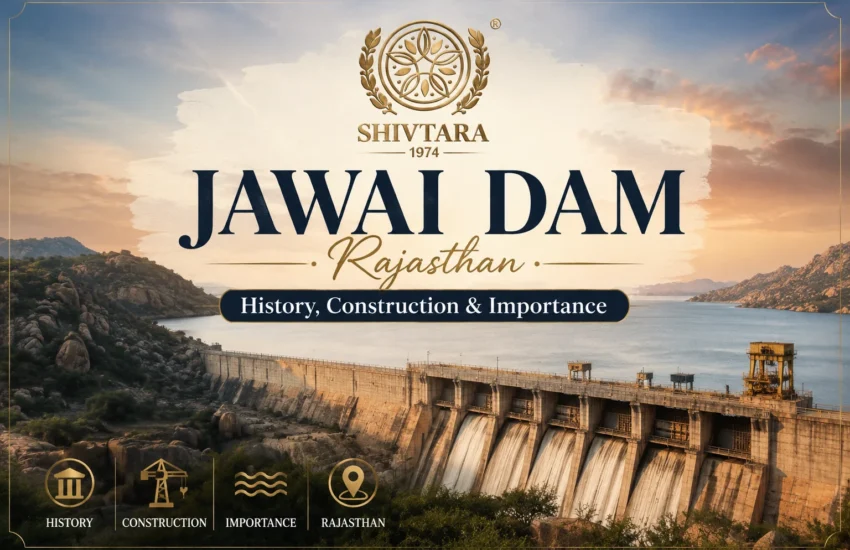
Tucked away in the arid, granite-strewn landscape of Pali district, Jawai Dam is one of Rajasthan’s most remarkable feats of engineering and one of its most rewarding travel destinations. Built across the Jawai River, a tributary of the Luni, this reservoir has quietly shaped the fortunes of the region for nearly seven decades — supplying drinking water, enabling irrigation, and, almost by accident, creating one of the finest leopard habitats in the world. Today, Jawai draws travelers from across the globe who come not just for the dam itself, but for the wetlands, rocky hills, and wildlife that have grown up around it.
The History Behind Jawai Dam
The story of Jawai Dam begins long before a single stone was laid. Every monsoon, the Jawai River would swell and overflow its banks, sending destructive floodwaters into the villages and farmland of Pali and Jalore districts. The idea of taming the river with a dam was first conceived in 1903, but it would take more than four decades for that vision to take concrete shape.
It was Maharaja Umaid Singh of Jodhpur who finally set the project in motion. Construction officially began on 12 May 1946, under the patronage of the Jodhpur royal family, with the twin goals of flood control and water security for the surrounding districts. The project faced setbacks along the way — by 1951, when India’s first Five-Year Plan was launched, a substantial sum had already been spent, and funding constraints slowed progress for a period. Despite these hurdles, the dam was finally completed in 1957, marking the end of a construction effort that had spanned more than a decade of labor in difficult, arid terrain.
Beyond the dam’s modern engineering history, the region itself carries a much older legacy. Local lore connects the area to the sage Javali, said to have meditated here in the Vedic age, and some traditions even link it to the Pandavas’ period of exile described in the Mahabharat. Over the centuries, the land around Jaitaran and Rohat passed through the hands of various rulers, adding layers of cultural depth to a landscape that is now equally famous for its natural beauty.
Construction and Engineering
Jawai Dam is an earthen and masonry structure, built using techniques that were considered advanced for their time. Rising to a height of roughly 51 meters from its foundation and stretching several kilometers in length, the dam was engineered to withstand both the force of monsoon flooding and the punishing heat of the Rajasthan desert. Thousands of laborers worked through harsh conditions to complete the structure, moving earth and masonry by hand in an era with limited mechanical assistance.
The reservoir it creates has a total capacity of around 207.5 million cubic meters, making Jawai Bandh the largest man-made dam in western Rajasthan. A network of one main canal and numerous distributaries carries water from the reservoir to the surrounding command area, while a spillway manages excess flow during heavy monsoons. The scale of the project — balancing flood control, irrigation, and drinking water supply within a single structure — reflects a level of planning that was genuinely ambitious for mid-20th-century India.
Why Jawai Dam Matters Today
A Lifeline for the Region
The primary purpose of Jawai Dam was always practical: to protect Pali district from flooding and to provide a dependable source of water. Even today, it remains a vital supply of drinking water and irrigation for a large population spread across Pali, Jodhpur, and Barmer districts, sustaining farmland in an otherwise water-scarce part of Rajasthan. Villages in Jalore district also benefit from irrigation supplies when reservoir levels are sufficient, underlining just how central this one structure has become to the region’s agricultural economy.
An Unexpected Wildlife Sanctuary
What makes Jawai truly extraordinary, though, is what happened around the dam after it was built. The submergence of the valley created wetlands that attracted birdlife, while the surrounding rocky outcrops and granite hills turned out to be ideal denning ground for leopards. Over time, Jawai became known as the “Leopard Capital of India,” home to one of the highest densities of leopards found anywhere in the world, living in close and remarkably peaceful proximity to local shepherd communities who revere the region’s sacred Rabari temples.
This unusual coexistence of big cats, pastoral communities, and a working irrigation dam has turned Jawai into a globally recognized wildlife destination. Safari drives through the granite hills now offer some of the most reliable leopard sightings anywhere in India, alongside sightings of striped hyenas, crocodiles basking near the water’s edge, and a rich variety of migratory birds that visit the wetlands each season.
A Growing Travel Destination
For travelers, Jawai offers a rare combination: the calm of a working reservoir, the drama of leopard territory, and the cultural texture of rural Rajasthan, all within a few hours of Jodhpur and Udaipur. Boat rides on the reservoir at sunset, walks among the granite boulders, and visits to nearby temples round out an experience that goes well beyond the dam’s original engineering purpose.
Anyone planning a trip to this part of Rajasthan will find that a stay close to the reservoir makes the whole experience far richer, putting sunrise safaris, lakeside walks, and village visits all within easy reach. For those looking to base themselves near the water and the leopard hills, it’s worth browsing the available rooms to find a stay that suits the pace of the trip, whether that’s a relaxed few days of wildlife watching or a quick weekend escape from the cities.
Conclusion
Jawai Dam stands as a genuine dual legacy — a piece of mid-20th-century engineering that solved a real and pressing problem for the people of Pali district, and, almost as a byproduct, the foundation of one of India’s most compelling wildlife landscapes. From its origins in 1903 as an idea to curb devastating floods, through its completion in 1957 under Maharaja Umaid Singh, to its present-day role as both an irrigation lifeline and a leopard sanctuary, Jawai Dam tells a story of how infrastructure and nature can end up deeply intertwined. For travelers seeking a destination that blends history, engineering, and raw wilderness in equal measure, few places in Rajasthan offer quite the same combination as Jawai.

