
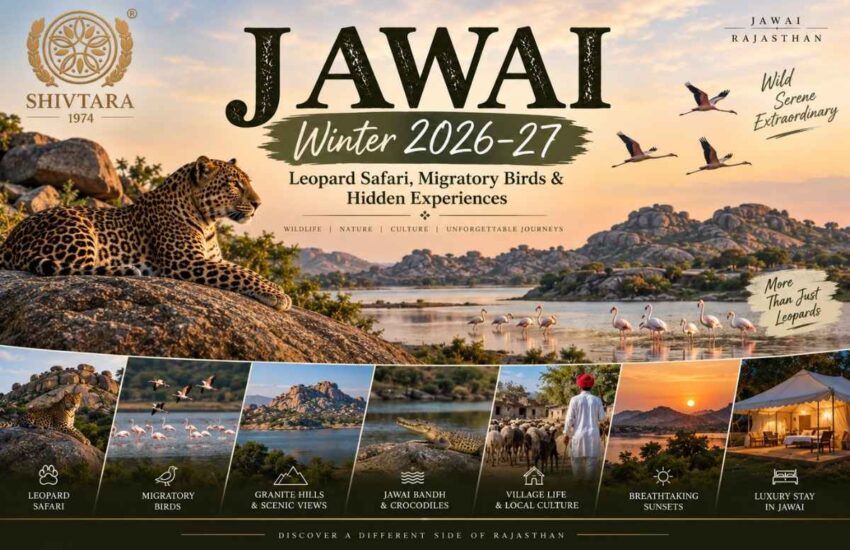
Winter brings a different character to Jawai, Rajasthan. From around October through March, cooler weather makes outdoor exploration more comfortable, while the backwaters of Jawai Bandh attract migratory birds. At the same time, the region’s famous granite hills continue to provide the setting for leopard safaris. Recent Jawai travel guides are already highlighting the 2026–27 winter season as a key period for combining wildlife, birdwatching and local experiences.
But a winter trip to Jawai does not have to revolve around one question: “Will I see a leopard?”
The region has much more to offer. From quiet village landscapes and ancient-looking granite formations to bird-filled wetlands, crocodiles and peaceful sunsets, winter is an opportunity to experience Jawai from several different perspectives.
Why Visit Jawai in Winter 2026–27?
The winter season, broadly from October to March, is considered a comfortable period for exploring Jawai. Morning and evening safari drives are easier to enjoy in cooler conditions, while the relatively dry landscape can provide clear views of the rocky terrain.
Recent local safari information also identifies October to March as a key period for birdwatching, with Jawai Bandh becoming particularly interesting for migratory species.
For travellers planning a Jawai Rajasthan holiday during 2026–27, winter therefore brings together several experiences in one trip:
- Leopard safaris
- Migratory birdwatching
- Jawai Bandh
- Granite hill landscapes
- Crocodile sightings
- Village experiences
- Local pastoral culture
- Sunrise and sunset photography
Rather than treating these as separate attractions, you can experience them as different parts of the same landscape.
1. Experience a Jawai Leopard Safari
The Jawai leopard safari remains one of the region’s best-known experiences.
What makes Jawai particularly interesting is its rocky terrain. Leopards use caves and crevices among the granite formations as shelter, while the surrounding scrubland and countryside form part of their wider habitat.
Safari routes can change according to wildlife movement, so every drive can be different. A leopard might be resting on a rocky ledge, moving between hills or remaining hidden from view.
This unpredictability is an important part of wildlife travel. Sightings depend on natural animal behaviour and cannot be guaranteed.
Winter also provides comfortable conditions for spending time outdoors during early-morning and evening drives. Current safari information lists October to February morning and evening safari periods, although exact timings can vary by operator and season.
2. Look Beyond Leopards at Jawai Bandh
Jawai Bandh is another major part of the winter experience.
The reservoir and its surrounding wetlands create an important habitat for birds. During winter, visitors may encounter migratory waterbirds alongside resident species.
Recent birding information for Jawai highlights species such as flamingos, bar-headed geese, northern pintails, pelicans, cranes and different waders during the October-to-March period.
For photographers, the combination of birds, open water and granite hills creates a very different visual experience from a leopard safari.
An early morning visit can be particularly peaceful. Instead of following a safari vehicle through rocky terrain, you can slow down and watch birds feeding, flying or resting around the water.
3. Watch Migratory Birds Arrive
Winter birdwatching is one of the experiences that can easily be missed by travellers visiting Jawai only for leopards.
According to current local birding information, Jawai’s wetlands support more than 150 resident and migratory bird species, although the exact species and numbers vary with season and conditions.
For bird lovers, November through February can be particularly interesting. Recent Jawai itinerary information also identifies this period as a time when flamingos, pelicans, cranes, geese, ducks and waders can be seen around the backwaters.
Carry binoculars if possible. A telephoto lens can also be useful for photography without getting too close to wildlife.
4. Look for Crocodiles Around the Water
Jawai’s wildlife experience extends beyond mammals and birds.
Mugger crocodiles can be found around the reservoir and its backwaters. During the cooler months, they may be seen basking on rocks or along the water’s edge.
Recent Jawai travel information specifically highlights crocodile viewing around Jawai Bandh during the winter period.
This makes a visit to the dam particularly rewarding because you can potentially experience several different forms of wildlife within the same landscape.
Of course, wildlife should always be observed from a safe and respectful distance.
5. Discover the Granite Hills
The granite hills are one of the defining features of Jawai.
Unlike the sandy landscapes associated with parts of Rajasthan, Jawai is characterised by huge rocky formations scattered across dry scrubland. These hills create the dramatic backdrop that has become closely associated with the region’s leopard country.
They are worth exploring even when there is no wildlife in sight.
During winter, the clearer and cooler conditions can make sunrise and sunset particularly enjoyable. The changing light brings out the textures and shapes of the rocks, while the surrounding countryside creates a striking contrast.
For anyone interested in landscape photography, the hills provide an opportunity to photograph Jawai without making the leopard the centre of every image.
6. Experience the Villages and Local Culture
Jawai is not an isolated wilderness separated from human life.
The surrounding landscape includes villages and pastoral communities, including the Rabari, whose traditional livelihood has historically involved livestock herding. Recent regional travel coverage describes the relationship between the pastoral communities, livestock and leopard habitat as an important part of Jawai’s distinctive character.
A respectful village experience can therefore add context to your wildlife trip.
Instead of seeing the hills only as safari territory, you begin to understand them as part of a lived-in landscape where people, animals and natural resources have long existed alongside one another.
This is one reason Jawai tourism can feel very different from visiting a conventional national park.
7. Enjoy Jawai at Sunrise and Sunset
Winter is also an excellent time to appreciate Jawai without following a fixed sightseeing schedule.
A sunrise over the granite hills can be quiet and atmospheric. Later in the day, the warm evening light creates a completely different appearance across the rocks and countryside.
For photographers, the morning and evening hours can offer softer light and strong contrasts between the granite formations and surrounding vegetation.
And if you have already spent several hours on safari, simply sitting somewhere peaceful and watching the landscape change can become an important part of the trip.
Where to Stay During Your Winter Jawai Trip
A longer stay allows you to experience more than one side of the region. Instead of arriving for a single safari and leaving immediately, consider staying for at least a couple of nights so you have time for wildlife, birdwatching, village experiences and the surrounding landscape.
A Luxury Stay in Jawai can provide a comfortable base between safari drives while keeping the focus of the trip on the natural surroundings.
The advantage of staying locally is also practical. Early-morning safaris can begin quite early, and being close to the safari area means less time spent travelling before the experience begins.
What Should You Pack for Jawai Winter?
Winter temperatures can change considerably between early morning, afternoon and evening, so layers are useful.
Consider carrying:
- A warm jacket for early-morning safaris
- Comfortable walking shoes
- Sunglasses and sunscreen
- Binoculars for birdwatching
- A camera with an appropriate zoom lens
- A reusable water bottle
- Neutral, comfortable outdoor clothing
If birdwatching is an important part of your itinerary, binoculars can make a significant difference.
Plan Your Jawai Winter 2026–27 Experience
Jawai’s winter season offers more than a chance to photograph a leopard.
It brings together wildlife, wetlands, migratory birds, granite hills, villages and quiet rural landscapes. A Jawai wildlife safari can introduce you to the region’s famous leopards, while a visit to Jawai Bandh can shift the focus towards birds and crocodiles.
The most interesting part is how closely these experiences connect.
The same granite hills that create Jawai’s iconic scenery provide shelter for leopards. The reservoir attracts birds and supports other wildlife. The surrounding villages and pastoral communities form another important part of the landscape.
That is what makes a winter visit to Jawai different.
Come for the leopard safari, but give yourself enough time to discover everything around it. The 2026–27 winter season can be an opportunity to experience Jawai as a complete wildlife and cultural destination rather than simply a place for one safari.

